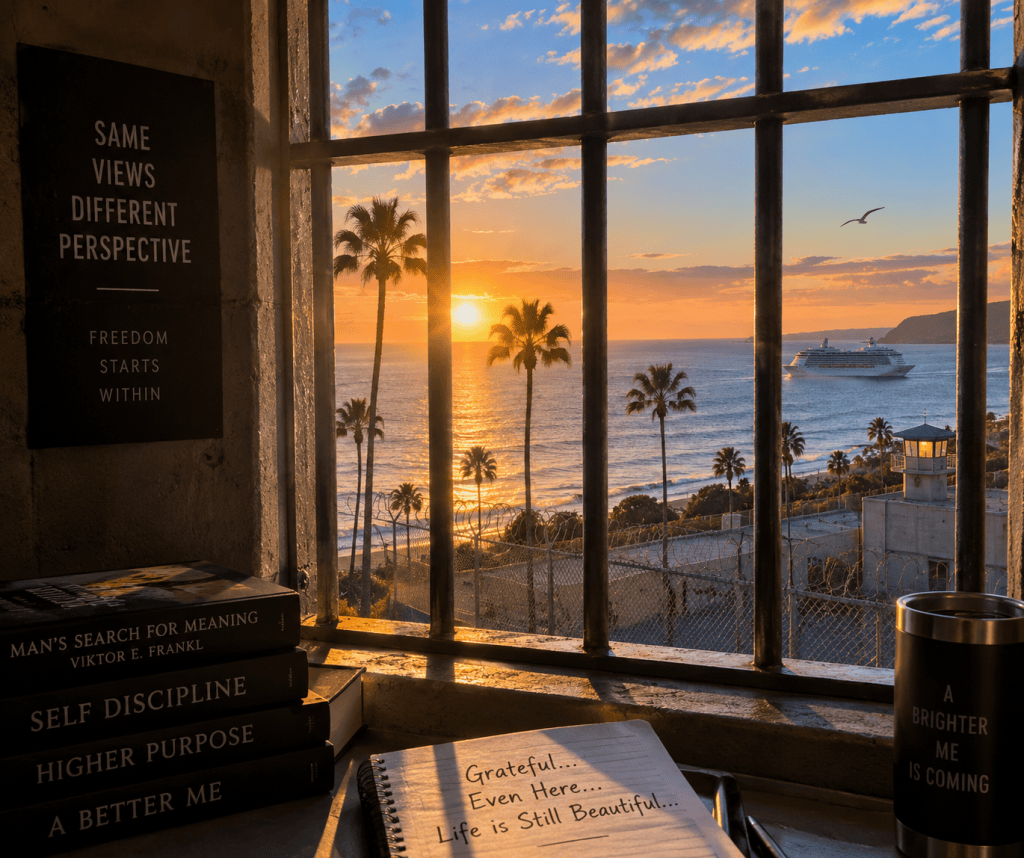
For a long time, I thought happiness was something that would happen to me when my circumstances changed. I thought I would be happy when I got out of prison, when I had money, when I had my own home, when I could go wherever I wanted, and when I finally had the things I had spent so many years dreaming about while sitting inside a prison cell.I was wrong.One of the biggest lessons I learned during my years of incarceration was that happiness isn’t something you find outside of yourself. It’s something you have a choice in creating. That doesn’t mean you can just decide to be happy and suddenly everything in your life becomes perfect. Life doesn’t work that way. There are going to be hard days, disappointments, losses, and situations that are completely outside of your control.What I learned was that even when I couldn’t control my circumstances, I could still have some control over how I looked at them.I didn’t learn that lesson sitting somewhere comfortable with everything going my way. I learned it while I was incarcerated.
A View I Never Expected to See From a Prison Cell
One of the moments that really drove this lesson home for me happened after I was transferred to Richard J. Donovan Correctional Facility in San Diego.Before Donovan, I had spent nearly 20 years in prisons in California’s Central Valley. The environment was completely different. The summers could be brutally hot, sometimes over 105 degrees, and when you looked outside the prison fences, you were surrounded by dirt and farmland. That was the world I had become accustomed to.Then I got transferred to Donovan.Donovan is down near the Mexico border and close to the coast. I remember looking outside and seeing palm trees. I could smell the salt water in the air. From my prison cell, I could look out the window and see the ocean. Every now and then I could even see cruise ships passing by.Think about that for a second.I’m sitting in a prison cell, and I can see the ocean.I had spent years surrounded by concrete, fences, razor wire, dirt, and the heat of the Central Valley. Now I could sit at my desk, study for my college exams, look out the window, and see the ocean and cruise ships going by.And it made me so happy.What made it even more powerful was that I wasn’t supposed to be there. I was still incarcerated. I still didn’t have my freedom. I couldn’t just walk outside and go down to the beach. I couldn’t get in a car and drive along the coast. I couldn’t get on one of those cruise ships.But I could see them.I could smell the ocean.I could see the palm trees.And I remember feeling incredibly grateful that I was able to experience something so beautiful while living in some of the harshest circumstances I had ever known.That experience taught me something that I didn’t fully understand before. Happiness doesn’t always require you to have everything you want. Sometimes it comes from recognizing what you already have.
Gratitude Changed the Way I Looked at My Life
That was when the attitude of gratitude started becoming much more meaningful to me.It’s easy to look at your life and focus on what’s missing. I could have sat in that cell thinking about everything I didn’t have. I could have focused on my freedom, my family, money, relationships, opportunities, and all the things I couldn’t do.And believe me, there were plenty of things I missed.But when I looked out that window, I started thinking about what I did have.I had my eyesight. I could see the ocean.I had my sense of smell. I could smell the salt air.I had my mind. I was able to study for college exams.I had another day of life.I had an opportunity to learn and grow even though I was incarcerated.Those things might sound small to somebody who has them every day. But when you have lived for years in an environment where so much has been taken away from you, you start to see ordinary things differently.That is what gratitude did for me. It changed what I was looking at.
Viktor Frankl Helped Me Put My Circumstances Into Perspective
Another major influence on the way I began looking at my circumstances was Viktor Frankl and his book Man’s Search for Meaning.Frankl’s work centered heavily around meaning, responsibility, and the ability to choose your attitude even when you don’t have control over the circumstances you’re facing. The Viktor Frankl Institute describes this as one of the central ideas of his work: people don’t always control the conditions they face, but they retain the ability to choose their attitude and response. That idea really hit me.I started thinking about my own circumstances differently. If I couldn’t change where I was, did that mean I had to spend every day being miserable? If I couldn’t walk out of the prison, did that mean I couldn’t experience happiness while I was inside?The answer I eventually came to was no.I couldn’t control being incarcerated, but I could control what I did with my time.I could read.I could study.I could exercise.I could meditate.I could work on myself.I could help other people.I could appreciate the little things.And I could choose not to allow my circumstances to completely control my emotional state.My own experiences eventually showed me just how true that could be. There were times after I was released from prison when I had the things I had dreamed about while incarcerated—children, a home, freedom, and the ability to live my life—and yet I was unhappy. At the same time, I can remember being genuinely happy on some of the most difficult prison yards I had ever lived on. My manuscript describes that contrast as one of the moments when I realized happiness was a choice. That realization changed me.
Happiness Doesn’t Mean Pretending Everything Is Good
I want to make something clear because I don’t want somebody reading this to think I’m saying that you should ignore the difficult things in your life.That’s not what I’m saying.There were plenty of terrible days in prison. There were days when I was angry, frustrated, afraid, disappointed, and tired of my circumstances. Choosing happiness doesn’t mean pretending those emotions don’t exist.It means not allowing those emotions to become your permanent address.You can be angry and still decide what you’re going to do next.You can be disappointed and still find something to be grateful for.You can be going through a difficult period and still take care of yourself.You can acknowledge that something in your life isn’t right without allowing it to convince you that your entire life is hopeless.That distinction became very important to me.
This Isn’t Just About Prison
You might be reading this and thinking, That’s great, Robert, but I’m not in prison.
Neither am I anymore, and that’s exactly why I still use these principles.
Because prison isn’t the only place where people become trapped. Some people are trapped by addiction. Some are trapped by anger. Some are trapped by resentment. Some are trapped by their past. Some are trapped in unhealthy relationships. Some are trapped by fear. And some people are trapped by the belief that they’ll finally be happy when something outside of themselves changes.I know that mindset because I’ve lived it.For years, I thought happiness was waiting for me somewhere in the future. I thought it was waiting on the other side of that prison gate. I thought that once I was free, had the things I wanted, and could finally live life on my own terms, I would automatically be happy. But when I eventually got those things, I discovered that happiness doesn’t work that way. My circumstances had changed, but my mindset hadn’t changed with them. My own experience taught me that you can be physically free and still feel trapped inside your own mind.
I’ve learned that sometimes the first step toward freedom isn’t changing your circumstances. It’s changing the way you respond to them.
That doesn’t mean you shouldn’t work to improve your circumstances. You absolutely should. If you’re struggling with addiction, work toward recovery. If you’re in a bad relationship, make changes. If you’re unhappy with your health, start taking better care of yourself. If your past is holding you back, start doing the work to heal and grow.
But while you’re working on changing your life, don’t make the mistake of believing that you have to wait until everything is fixed before you allow yourself to experience happiness.
You can start today.
You can start with your attitude. You can start with gratitude. You can start by taking responsibility for the things you can control and letting go of the things you can’t.
Three Things I Still Practice Today
The lessons I learned in prison didn’t disappear when I walked out of the gates. If anything, they became even more important once I was free.
The first thing I do is check my attitude.
I take a mental temperature of where I’m at. Am I angry? Am I frustrated? Am I allowing something that happened earlier to affect the rest of my day? Am I focusing so much on what’s wrong that I’m completely ignoring what’s right?Sometimes simply recognizing what is happening inside your own head gives you an opportunity to change direction. My goal isn’t to pretend I’m always positive. I’m not. My goal is to catch myself before a temporary emotion turns into an entire day of negativity.
The second thing I do is choose gratitude.
I intentionally look for things I can be thankful for. Sometimes it’s something major, and sometimes it’s something as simple as being able to walk outside, having a good workout, eating a good meal, talking to someone I care about, or simply having another day to work on myself.When you start counting your blessings, you begin noticing things you used to take for granted.That’s what happened to me looking out that prison window at Donovan. I could have looked at the fences and thought about everything I couldn’t do. Instead, I looked beyond the fence and appreciated what I could see.
The third thing I do is give something away.
I’m not talking about money. Give somebody your time. Give somebody encouragement. Share something you’ve learned. Help someone who is struggling. Make somebody laugh. Tell someone you appreciate them.When you’re constantly focused on yourself, your problems can become enormous. Sometimes helping another person reminds you that you have something valuable to contribute.And that can be powerful for your mental and emotional well-being. It can also encourage you to get out of your own head, move your body, connect with other people, and create a greater sense of purpose in your everyday life.
You Don’t Have to Wait for Your Life to Be Perfect
Maybe you’re reading this and you’re not in prison. Maybe you’re dealing with something completely different.Maybe you’re struggling with addiction, anger, depression, financial problems, a broken relationship, regret about your past, or simply the feeling that your life isn’t where you thought it would be.I understand that feeling.I’ve learned that sometimes we spend so much time waiting for our circumstances to change that we forget we can change ourselves while we’re waiting.That’s what I did in prison.I couldn’t walk out of the gate when I wanted to. I couldn’t change the sentence I was serving. I couldn’t control everything happening around me. But I could decide what I was going to do with the life I had that day.I could study.I could exercise.I could read.I could work on my mind.I could practice gratitude.I could look out that window and appreciate the ocean.And I could choose to be happy.That choice didn’t make prison disappear. It didn’t magically change my circumstances. What it did was give me a different way of experiencing the life I was living.And that’s something I still carry with me today.Happiness isn’t about having everything you want. I’ve learned that firsthand. Sometimes you can have almost everything you once dreamed about and still be miserable. Other times, you can have very little and find a moment of genuine happiness simply because you choose to recognize the good that’s already there.For me, that lesson started behind bars.I learned it looking through a prison window at palm trees, smelling the ocean, watching cruise ships pass by, and realizing that even though I wasn’t free yet, there were still beautiful things in my life.That was when I started understanding the power of gratitude.That was when I started understanding the power of choice.And that’s a lesson I still practice today.
APEX ACTION STEPS
1. Check your attitude.Take five minutes today and ask yourself honestly: What am I feeling, and is the way I’m looking at this situation helping me or hurting me?
2. Count your blessings.Write down five things you have today that you normally take for granted. Don’t overthink it. Start with the simple things.
3. Give something away.Give someone your time, encouragement, knowledge, kindness, or help without expecting anything in return.
You may not be able to control everything happening in your life. Neither can I.But you can decide what you’re going to do with what you have.And sometimes, that choice is where real freedom begins.**This is The Apex Journey. One choice, one day, one step at a time.**
 theapexjourney